N. Claude Cohen ז״ל – A Drug Design Pioneer
drugdesign.org is dedicated to the memory of Dr. N. Claude Cohen, a pioneer in molecular modeling and drug design.

Dr. Cohen devoted his life both to developing new approaches to drug design and to discovering new drugs. He was a scientist, researcher, theorist, programmer, and teacher. Over the course of his career, he spent what added up to years inside the active sites of proteins, wearing stereoscopic glasses, observing interactions, adding new atoms, and trying to understand their implications. Those who knew Claude remember him as a modest and beloved man.
Cairo, Egypt (1941–1956)
Claude Cohen was born in Cairo in 1941 into a Jewish family, to a Lebanese father and a Syrian mother. In 1956, in the aftermath of the Suez Crisis, the Cohen family was expelled from Egypt. They planned to emigrate to Brazil, but at the last minute obtained an entry visa to France.
Paris, France (1956–1983)
Claude received his Ph.D. in Organic Chemistry from the University of Paris in 1967. Standing in for his thesis advisor, who was stranded in Cuba, he gave his first lecture, entitled “Chemistry Is a Three-Dimensional Science.” He was ahead of his time: chemistry was then still thought of in two dimensions. He immediately joined Roussel-Uclaf (now Sanofi) in Paris, where he headed the Theoretical Medicinal Chemistry department and led his team in numerous drug discovery programs in cardiovascular disease, CNS, infection, immunology, and oncology.
Dr. Cohen developed many innovative computer programs. The picture below is a snapshot of Script, the first software to generate 3D molecular structures from 2D representations. On the left, the user draws a molecule; on the right, the program generates a list of conformers with their associated energies. Script had its own force field and molecular file format.

Basel, Switzerland (1983–1996)
In 1983, he joined Ciba-Geigy (now Novartis) in Basel as Head of Molecular Modeling and Drug Design. His group successfully integrated modern rational drug design into the company's research projects. Together with his colleagues, Dr. Cohen contributed to the discovery of several drugs, including valsartan (Diovan) and aliskiren (Tekturna/Rasilez), a renin inhibitor that reached the market in 2007. At Ciba-Geigy, Dr. Cohen continued to develop innovative methods. The picture below shows scaffolds suggested by his program NewLead.

The picture below shows the hypothetical binding model of aliskiren, designed by Dr. Cohen, in the renin protein. At the time, no renin structure was available in the PDB, so the design was based on a homology model built from penicillopepsin. The team wrote a signed and dated document summarizing their structure-based predictions, to serve as a basis for comparison with experimental X-ray data once these became available. These predictions were confirmed experimentally one year later.

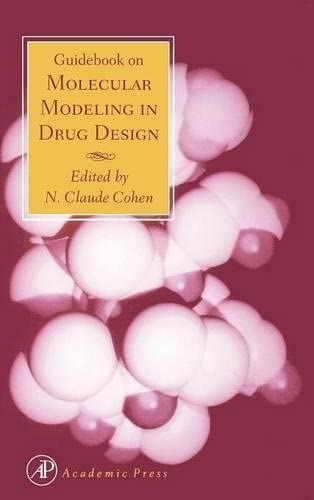
In 1996, Dr. Cohen edited the Guidebook on Molecular Modeling in Drug Design, published by Academic Press.
Jerusalem, Israel (1996–2010)
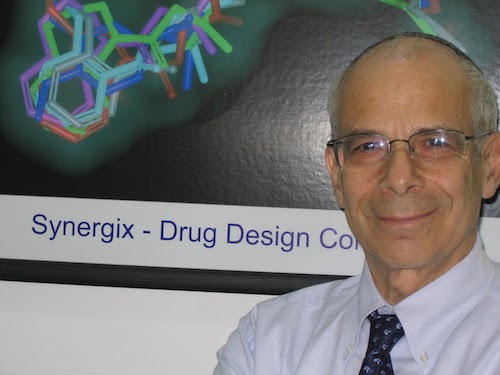
That same year, Dr. Cohen fulfilled a lifelong dream of moving to Jerusalem, where he founded Synergix Ltd., a company that developed educational resources in drug design, molecular modeling, cheminformatics, and medicinal chemistry.
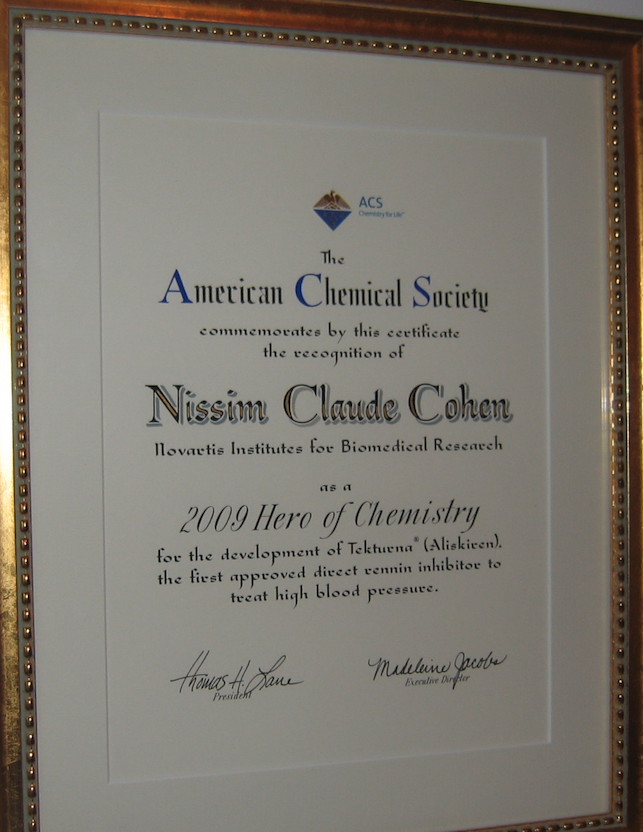
In July 2009, the American Chemical Society named Dr. Cohen a Hero of Chemistry for the discovery and development of aliskiren, the first-in-class renin inhibitor. Heroes of Chemistry is an annual award from the American Chemical Society. It honors teams responsible for innovative and impactful products based on chemistry and chemical engineering.
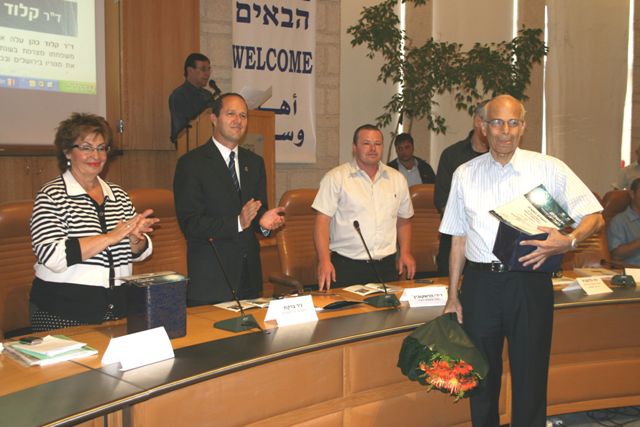
In 2010, the City of Jerusalem honored Dr. Cohen with a prize for his scientific contributions to the State of Israel and the city of Jerusalem.
Dr. Cohen passed away in Jerusalem at the age of 69, after a long illness. He is survived by his wife, a daughter, and two sons.